Fibre optic is on the rise in Switzerland – but it's not available everywhere, not worthwhile for everyone, and not equally good with every provider. This guide helps you ask the right questions: do you actually have FTTH at your address? Do you really need 1 Gbit/s? And is it worth switching from Swisscom to a cheaper specialist provider?
What does fibre optic mean – and what technology do you actually have?
Not every connection marketed as "fibre optic" is genuine FTTH (Fiber to the Home). The difference is crucial for your actual speed.
The three most important technologies at a glance
| Technology | Meaning | Fibre up to | Last mile | Max. downstream |
|---|---|---|---|---|
| FTTH | Fiber to the Home | Directly into the home | Fibre optic | 10 Gbit/s+ |
| FTTC | Fiber to the Curb | Street cabinet | Copper (VDSL) | ~100–300 Mbit/s |
| HFC | Hybrid Fiber Coax | Neighbourhood node | Coaxial cable | ~1 Gbit/s (shared) |
FTTH is the only technology where fibre optic is genuinely run all the way into your home. You get a dedicated line – no shared bandwidth with neighbours, symmetrical upload and download speeds, and a future-proof infrastructure.
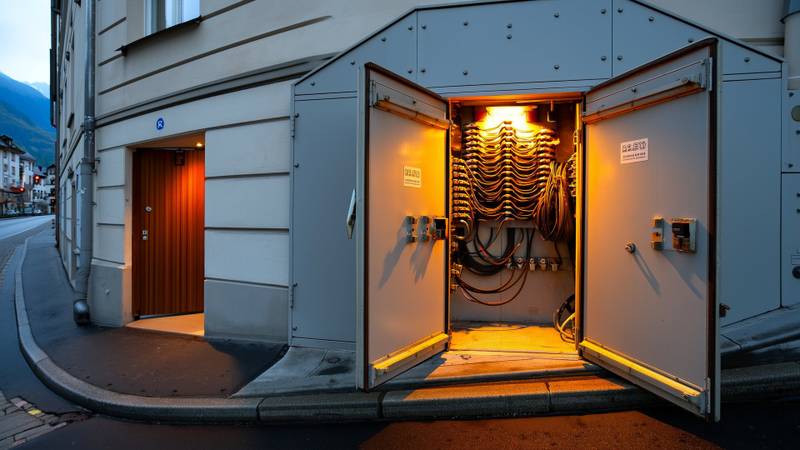
FTTC (also called "Fiber+" or "fibre hybrid") only uses fibre optic up to the street cabinet. The last few metres to your home still run over old copper cable. The further you are from the cabinet, the slower the connection.
HFC – the cable network of Sunrise/UPC – is also a hybrid technology. Bandwidth is shared within the neighbourhood, which can lead to fluctuations during peak hours.
Swisscom's ongoing DSL phase-out makes this distinction even more important: anyone still relying on copper today will sooner or later have to switch. Find out in our article on the DSL phase-out in Switzerland what this means for you specifically.
Fibre optic availability in Switzerland 2026
Switzerland is among the countries with the highest FTTH rollout rate in Europe. Swisscom continued to advance its expansion targets in the first quarter of 2026. Nevertheless: not every address is connected – particularly in rural areas and mountain regions, there are still large gaps.
How to check availability at your address
The most reliable method is a direct address search with the provider:
- Swisscom: shop.swisscom.ch → address check in the ordering process
- Init7: init7.net → availability check with indication of the fibre network operator
- iWay: iway.ch → address check with technology indication
- Sunrise: sunrise.ch → availability check
- M-Budget (Migros): mbudget-mobile.ch → uses the Swisscom network
Important: fibre optic connections in Switzerland are usually built by one of the three major network operators – Swisscom, Sunrise (formerly UPC) or local municipal utilities (e.g. ewz in Zurich, IWB in Basel, Energie Wasser Bern). Internet providers rent this infrastructure and offer their services on top of it. You can therefore take out a fibre subscription with Init7 or iWay that physically runs over the Swisscom network.
What to do if FTTH is not available?
If FTTH is not yet available at your address, you have the following options:
- Wait and monitor: Swisscom and municipal utilities are continuously expanding. Check availability again every six to twelve months.
- HFC as an alternative: Sunrise's cable network offers speeds of up to 1 Gbit/s in many areas.
- Bridge with FTTC: if you get 100–300 Mbit/s, that's still sufficient for most households.
When is 1 Gbit/s really worth it?
One of the most common questions: do I even need that much bandwidth? The honest answer: for many households, 300–500 Mbit/s is perfectly sufficient. But there are clear scenarios where 1 Gbit/s makes a noticeable difference.
Use cases at a glance
Home office (1–2 people) Video conferences (Teams, Zoom) require around 5–10 Mbit/s per connection. Even with several parallel calls and cloud synchronisation, 100 Mbit/s serves you well. 1 Gbit/s brings no noticeable added value here – unless you regularly transfer large files.
Gaming For online gaming, it's not bandwidth but latency (ping) that matters. FTTH typically offers very low latencies. However, the download size of modern games (50–150 GB) does benefit from high speeds: a 100 GB game downloads in about 15 minutes at 1 Gbit/s, while at 100 Mbit/s it takes over two hours.
4K streaming and multiple users simultaneously Netflix recommends 25 Mbit/s for 4K. But if four people are simultaneously streaming, gaming, working from home and syncing files, the demand quickly adds up to 200–400 Mbit/s. Here, 1 Gbit/s makes sense – especially looking ahead to the next few years.
Symmetrical upload This is the biggest advantage of FTTH over cable and FTTC: upload and download are equally fast. Anyone who regularly uploads large files (cloud backups, video uploads, remote NAS access) benefits enormously from symmetrical speeds.
Provider comparison: Swisscom vs. specialist providers
The biggest difference between Swisscom and providers like iWay, Init7 or M-Budget lies not in line quality – the fibre infrastructure is the same – but in price, contract terms and philosophy.
What sets the providers apart
Swisscom The market leader offers nationwide availability, its own customer service and a broad product portfolio (internet, TV, mobile as a bundle). You pay a premium for this. Contracts often run for 24 months, and prices are among the highest in the market.
Init7 Init7 is known for its transparency, technical expertise and consistent use of open standards. The company offers flat-rate connections without throttling and communicates openly about network capacities. Particularly popular with tech-savvy users and home office workers who value reliability. Init7 offers fibre connections via the Swisscom network as well as via its own infrastructure.
iWay Another independent Swiss provider focusing on private and business customers. iWay scores with flexible contract terms and good customer service. Here too, the fibre infrastructure is provided by Swisscom or municipal utilities.
Teleboy Teleboy is primarily known as a TV provider but also offers internet connections. Interesting for customers who want to combine TV and internet without switching to one of the major providers.
M-Budget Internet The Migros label offers affordable internet connections via the Swisscom network. If you don't have high demands on customer service and are looking for a simple, cheap subscription, this is a good fit. No long contract terms, no extras.
What to look out for when comparing
- Contract term: 12 months, 24 months or cancellable monthly? Shorter terms give you more flexibility.
- Connection fee: some providers charge a one-off activation fee, others don't.
- Router: is a router included? Can you use your own? Init7 and iWay generally allow the use of your own hardware – an advantage for technically savvy users.
- Customer service: availability in English, response times, quality of fault resolution.
- Price transparency: are there hidden costs after the first year? Does the price increase after a promotional period?
You can find a detailed price comparison of current fibre subscriptions in our internet subscription comparison 2026.
Switching checklist: how to switch without pitfalls
Switching providers in Switzerland is well regulated, but there are a few points you should clarify in advance.
Before switching
- Check availability: is FTTH available with the new provider at your address?
- Check your contract: when does your current contract expire? What notice period applies (usually 30 days before the end of the contract)?
- Dissolve the bundle: do you have internet, TV and mobile as a package? Clarify whether you can cancel individual services separately or whether the entire bundle has to be dissolved.
- Factor in the connection fee: some providers charge a one-off fee for activating the fibre connection.
During the switch
- Seamless transition: many providers coordinate the switch so that you have no interruption. Ask about this explicitly.
- Router compatibility: check whether your existing router is compatible with the new connection. FTTH often requires an ONT (Optical Network Terminal), which is installed by the network operator.
- Email addresses: if you use an email address from your previous provider (e.g. @bluewin.ch), you will lose it when you switch. Set up an independent address in good time.
After switching
- Measure your speed: test the actual speed with an independent tool (e.g. fast.com or speedtest.net) – ideally via cable, not over Wi-Fi.
- Get cancellation confirmed: make sure your old provider has confirmed the cancellation in writing.
Conclusion: who is switching worth it for?
Fibre optic is worth it for you if:
- FTTH is available at your address and you're still on copper or cable
- Your household uses the internet intensively – multiple people, home office, gaming, streaming
- You need symmetrical upload – for cloud backups, NAS or regular large uploads
- You want to switch to a cheaper provider – specialist providers like iWay or Init7 often offer better terms than Swisscom
Switching is less worthwhile if:
- You already have 300–500 Mbit/s and live alone or as a couple
- Your contract still has a long time to run and the switching costs cancel out the savings
- FTTH is not yet available at your address
Compare current offers directly on our internet overview page and find the right subscription for your household.